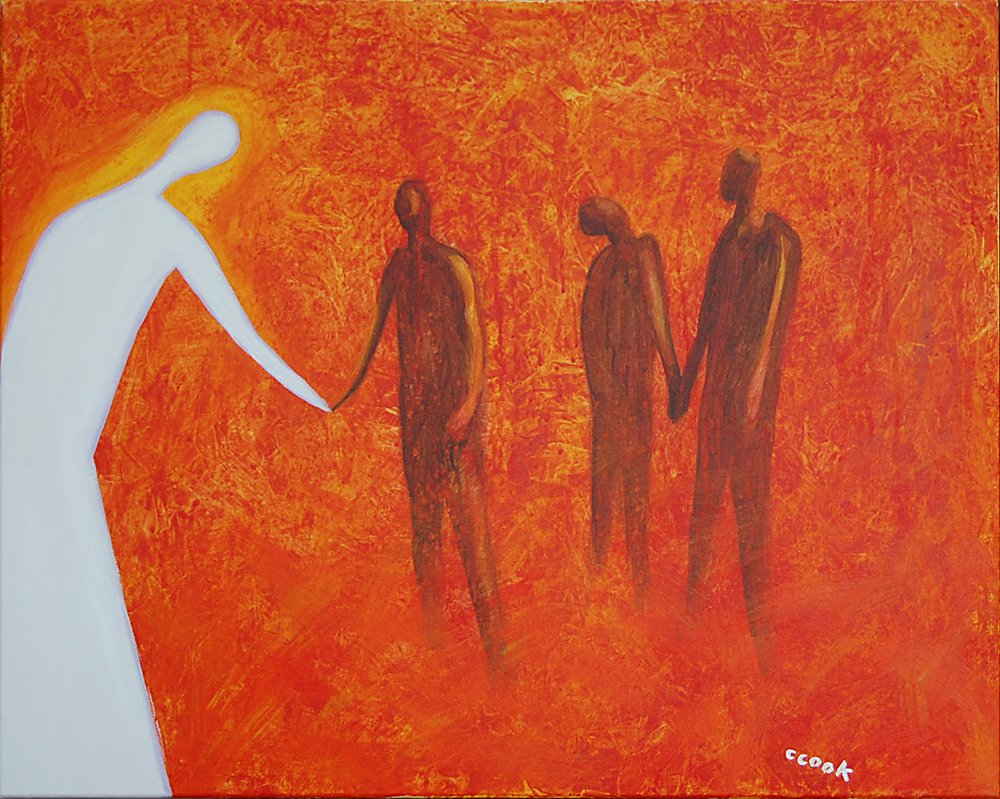
“You Can’t Legislate Morality”

Paul asks, “Why then the Law?” (Gal 3.18). If the promises of God come by faith rather than by law, then why bother giving the Law of Moses in the first place? Paul answers this question in terms of salvation and God fulfilling His promises, but we can consider the question from another angle: Israel was a physical nation that needed laws.

We can see how necessary the Law was when we consider some of the things it protected against. It prohibits rape and provides severe punishments for it (Dtr 22.25-27). It prohibits some forms of slavery (Lev 25.39-42), protects slaves from abuse (Lev 25.43), protects fugitive slaves (Dtr 23.15-16), limits the amount of time a man can be kept enslaved (Exo 21.1-2), and requires that new freedmen be sent away with ample provisions (Dtr 15.12-15). It protects widows, orphans, and foreigners.

Without God enforcing the Law, whether through the Israelite community, the priests, or the king, who would stand up for the vulnerable in society? The answer in the Ancient Near East was often, “No one.” Most people lived as subsistence farmers. They usually barely had the means to keep themselves alive, let alone some “useless” stranger. On the contrary, vulnerable people were easy targets, and stealing from them or oppressing them would make it that much easier for you to feed your family. Abuse was rampant in the ancient world, just as it is today.

Take the story of Jacob and Laban as an example. Jacob has fled from the wrath of Esau after swindling him out of his birthright and Isaac’s blessing (Gen 27.36, 41-45). The text has a little fun at Jacob’s expense as he sojourns in Haran, showing us how the heel grabber and master swindler is repeatedly out-swindled by his Uncle Laban. Laban infamously gives Jacob the wrong wife so as to extort more labor out of him, but his swindling doesn’t end there. Jacob works as a shepherd for Laban not only in exchange for Rachel but also for flocks of his own. In this payment also, Laban fleeces Jacob:

So Jacob sent and called Rachel and Leah into the field where his flock was and said to them, “I see that your father does not regard me with favor as he did before. But the God of my father has been with me. You know that I have served your father with all my strength, yet your father has cheated me and changed my wages ten times. But God did not permit him to harm me. If he said, ‘The spotted shall be your wages,’ then all the flock bore spotted; and if he said, ‘The striped shall be your wages,’ then all the flock bore striped. Thus God has taken away the livestock of your father and given them to me. (Gen 31.4-9)

Jacob flees toward home, and Laban pursues. When Laban finally catches up with Jacob, he makes it very clear that it is within his power to harm Jacob (Gen 31.29). In the end, it is determined that Jacob has not wronged Laban, the two men make a covenant, and they return to their respective homes. Jacob was blessed. If he didn’t have the hand of God protecting him–and the family structure and the laws which God used in protecting him–then Laban would surely have kept on abusing him. What could Jacob have done to stop Laban? Jacob was treated as a foreigner. Despite being a wealthy man, he had few options apart from fleeing.

Was that the best possible outcome for Jacob? Jacob seems to think not, as he tells Laban, “There I was: by day the heat consumed me, and the cold by night, and my sleep fled from my eyes. These twenty years I have been in your house. I served you fourteen years for your two daughters, and six years for your flock, and you have changed my wages ten times” (Gen 31.40-41). It may not have been the best possible outcome, but it certainly wasn’t the worst.

Like any set of laws, the Law of Moses existed to keep human wickedness in check and limit its bad outcomes. We should bear this in mind today as we consider the laws that we implement. We often hear the cliché, “You can’t legislate morality.” The Law of Moses agrees. Changing the heart is not the point of the law. The prophets argue this repeatedly, saying that true righteousness is a function of the heart rather than just following the rules. It’s important that we divide the function of law from the function of faith and not expect the law to do what only faith can do. On the contrary, we should let each have its function: faith for the faithful to obtain the promises of God, and law for the rest to prevent them from making things miserable for us all. We absolutely should legislate to limit bad outcomes. We should not demand that a law make people righteous before we consider passing it.

Through the Eye of a Needle

Andy Warhol’s final completed commission was a series of over 60 variations on Leonardo da Vinci’s famous The Last Supper (1496). Warhol is best known for his pop art, which often includes commercial images, such as Campbell’s Soup Cans (1962). The above variation on The Last Supper combines two of Warhol’s greatest fascinations: American commercialism and Jesus of Nazareth (Warhol was a Ruthenian Rite Catholic).

This particular variation is too deep to cover sufficiently in this space, so I want to focus on the way Warhol relates the two sets of elements in the painting: the colorful commercial images–a red “59ȼ” advertisement, two pink Dove soap logos, and a blue General Electric logo–superimposed over an austere black-and-white outline of Jesus and the apostles taking the Supper.

We are intimately familiar with both sets of elements. Da Vinci’s The Last Supper is one of the most identifiable pieces of art in the world, and it represents one of the centerpieces of Christian worship. How could we not recognize our Lord revealing to the twelve that one of them would betray Him? Likewise, how many of us would fail to recognize the logos for Dove or for GE? How often have we seen “value prices” advertised in shop windows?

What shocks us is the way in which Warhol combines these otherwise familiar elements. We do not expect to see a bubblegum pink Dove logo hovering over the Lord’s right shoulder. But that is precisely the point. By shocking us in this way, Warhol is opening our eyes, that “seeing, we may perceive.”

The piece’s commercial elements do two important things: they obscure Jesus and the apostles, and they distract from Jesus and the apostles. They do both of these jobs so well that Warhol challenges us to identify the piece’s true subject. Is this a depiction of the Last Supper, like da Vinci’s original, focused on Jesus of Nazareth sharing the Passover seder with his apostles? Or is it about something commercial, essentially an ad for Dove soap or for General Electric? By making us ask these questions inside of the artwork, Warhol invites us to take them outside of the artwork and into our own lives.

Brands and their advertisements dominate modern life. This is what one means by “commercialism” in the cultural sense: that we live and experience the world predominantly in terms of profit-making mechanisms, such as brands, logos, and ads. Answering simple questions like “What shall we have for supper?” inevitably involves a parade of brand names, whether we choose to eat out at Chick-fil-A or McDonalds or to stay in and pull out some Johnsonville brats or DairyPure milk from the Frigidaire. Brands, logos, and ads are so ubiquitous that we don’t even bat an eye at them. We hardly notice them–and the incredible worldly wealth they represent.

Jesus exclaimed after the sullen departure of the rich young ruler, “How difficult it is for those who have wealth to enter the kingdom of God! For it is easier for a camel to go through the eye of a needle than for a rich person to enter the kingdom of God.” Our wealth, like the logos in Warhol’s The Last Supper, distracts us from the Lord and from the inspired teachings of the apostles. It obscures what ought to be clear and plain to us about God and the life eternal.

Branding is merely repackaged materialism. It is the lust of the eyes, the lust of the flesh, and the pride of life wrapped in cellophane. And it depends entirely on you thinking of your life in material terms: what shall I eat? what shall I drink? what shall I wear? Your life consists of more than these things. Turn your attention instead to Jesus and what the Supper teaches us. He gave His body and blood for us, so we ought to lay down our lives for the brothers.

May God always rouse us when we sleepwalk into idolatry.

Continue reading “Through the Eye of a Needle”

The Beatitudes

The Beatitudes in the Sermon on the Plain (Luke 6.20-26) differ in some important ways from the Beatitudes in the Sermon on the Mount (Mat 5.2-11). Why does Luke have Jesus speaking in economic rather than spiritual terms (e.g., “Blessed are the poor” instead of “Blessed are the poor in spirit”)? Why does Luke’s account include a parallel set of woes?

Presented 11 February 2018

“Is It Legal?”

The following was published in the 14th Avenue Church of Christ bulletin on 11 February 2018.

At the beginning of Star Wars: Episode I – The Phantom Menace, Darth Sidious instructs Trade Federation Viceroy Nute Gunray to land his invasion force on the planet Naboo. Gunray asks, “My Lord… is it… legal?” Sidious cynically responds, “I will make it legal.” This exchange, like most of The Phantom Menace, is over-the-top. The Trade Federation is obviously acting in bad faith against Naboo, and Gunray’s question is pragmatic rather than ethical or moral. He is not concerned with doing right but rather with getting away with it.

Our moral failings are usually not so obvious as Nute Gunray’s, but that doesn’t make us immune to his mode of thinking. Rather than thinking of our behavior in terms of “Should I?” we think of it in terms of “Can I?” The Bible teaches us through many examples that this type of thinking is morally disastrous.

In Daniel 6, King Darius’s advisors plot to use Daniel’s faith against him. They convince Darius to require everyone in the Empire to pray through the king. The advisors know that Daniel will disobey, so all they have to do is wait. Sure enough, Daniel refuses to break faith by praying through the king, so the advisors bring their accusation against him. The law forces the king to condemn Daniel to the lions’ den, but God delivers Daniel.

The king’s advisors do not fare so well. It was common in the law codes of the Ancient Near East to punish false witnesses by giving them the sentence of the person they had accused. Such happens to the king’s advisors at the end of Daniel 6. The king casts them into the lions’ den, where they die.

But wait–were the advisors false witnesses? Their accusation against Daniel was true; he was breaking the law. And the law was very clear: any man who did not pray through the king was to be put to death. Here we see Gunrayism on display: the advisors told the truth, but they were not honest; they kept the law, but they were not just.

In Luke 20, the scribes, the chief priests, and the Sadducees are in a bind. They want Jesus dealt with, in the same way that the Mafia deals with people. Unlike the Mafia, the Sadducees and their sycophants are too “scrupulous” to do the dirty work themselves. Rather, they are too cowardly. Luke tells us that “they feared the people” (Luke 20.19). They would also have feared the Romans, who enforced a monopoly on capital punishment. “So they watched him and sent spies, who pretended to be sincere, that they might catch him in something he said, so as to deliver him up to the authority and jurisdiction of the [Roman] governor,” i.e., to be put to death (Luke 20.20).

The Sadducees take a crack at catching Jesus in His words with a question about levirate marriage and the Resurrection (Luke 20.27-33). The Sadducees, of course, don’t believe in the Resurrection. They claim to follow only the Torah. They ask about the Resurrection because they think that their question may get Jesus hanged (see Dr. David McClister’s lecture, “‘Now there were seven brothers…’: What Was So Dangerous About This Question?” for an explanation). Jesus turns the tables on them in His response: “But that the dead are raised, even Moses showed, in the passage about the bush, where he calls the Lord the God of Abraham and the God of Isaac and the God of Jacob. Now he is not God of the dead, but of the living, for all live to him” (Luke 20.37-38). Whereas the Sadducees thought to catch Jesus in his words, Jesus has now caught the Sadducees in their words: if they say that they follow only the Torah, then they must confess the Resurrection.

Ultimately, though, Jesus gives the chief priests what they want. After searching fruitlessly for false witnesses to accuse Jesus of a punishable crime, the frustrated high priest gets up and says to Jesus, “I adjure you by the living God, tell us if you are the Christ, the Son of God.” Jesus Himself utters the words that will get Him hanged: “You have said so” (Mat 26.63-64). The priests then deliver Jesus over to Pilate, and He is hanged, and their hands are clean. Everything is nice and “legal.” But these false witnesses bear the penalty on their own heads, for “whoever denies me before men, I also will deny before my Father who is in heaven” (Mat 10.33).

Gunrayism is a specific kind of legalism. All legalism seeks to reduce the broad moral character of God’s Law to a narrow set of rules to follow. Legalism makes the Faith into a checklist. If I do this thing and that thing (or five things), and if I don’t do this, that, and the other thing, then that makes me faithful to God. I have done what is legal. So did King Darius’s advisors. So did the scribes, the chief priests, and the Sadducees. But in the end, they all faced the Lion. And so shall we.