“I Would Die For Jesus”

The danger in reading stories like “The Burning, Fiery Furnace” and “Daniel in the Lions’ Den” is that we tend to apply romantic notions to such dramatic acts of faith. We imagine ourselves as heroes of the Faith, facing down certain death to confess Jesus before a murderous, heathen tyrant. “Of course I would die for Jesus,” we think. Our daydreams teach us that great faith consists in dying for the Lord.

We discover the truth if we reverse the proposition. Facing down death for the Lord’s sake is an act of great faith. Let us never downplay the courage of Hananiah, Mishael, and Azariah as they withstood the king’s fiery rage. Let us never dismiss Daniel’s fidelity as he continued in righteous prayer. The Hebrew writer says of the heroes of faith, “They were stoned, they were sawn in two, they were killed with the sword. They went about in skins of sheep and goats, destitute, afflicted, mistreated–of whom the world was not worthy–wandering about in deserts and mountains, and in dens and caves of the earth” (Heb 11.37-38). We are to hold the martyrs in the highest esteem.

So what do we mean when we say that these stories can be dangerous to us? The danger is not in saying that martyrdom is an act of great faith. It is in saying the reverse: that great faith consists of facing down death for the Lord.

We cannot reduce the Faith to matters of physical life and death. To do so cheapens it. First, how many of us honestly expect to stand before a Nebuchadnezzar? Do we imagine somehow falling into the clutches of ISIS or Al Qaeda? I admit, the image leaves a strong impression: hands bound, kneeling, a gun pressed against the temple as a raging jihadist demands that we renounce Christ. And, yes, many Christians have suffered that ordeal. But is that likely to happen to you? The odds of dying in the U.S. at the hands of an Islamist for any reason are miniscule, and actual martyrdom for Christ is almost unheard of in the U.S. We cheapen the Faith and the sacrifices of the martyrs when we daydream fancifully about events that will almost certainly not befall us.

More importantly, we cheapen the Faith when we reduce it to a single act of defiance against the world. Dwelling too much on the question, “Would you die for Jesus?” has us constantly looking forward to when we can finally prove our faith in a blaze of glory. What if the moment never comes? What are we doing with ourselves while we wait for it?

Ironically, the answer comes from King Nebuchadnezzar. Nebuchadnezzar praised Hananiah, Mishael, and Azariah because they “yielded up their bodies rather than serve and worship any god except their own God” (Dan 3.38). He could not have known how right he was about the nature of their resolve. Paul uses the same language when he writes, “I appeal to you therefore, brothers, by the mercies of God, to present your bodies as a living sacrifice, holy and acceptable to God, which is your spiritual worship” (Rom 12.1). What Hananiah, Mishael, and Azariah did intending to die, Paul tells us to do intending to live. We ought to be offering up our lives even when there is no furnace, no lion, no sword, no gun threatening us.

This is the martyr’s secret, by the way. Again, we cannot reduce the Faith to a single act of defiance, and there is no exception for the martyr. Where do we suppose the martyr gets the strength to say, “Be it known, O king, that we will not serve your gods or worship the golden image that you have set up” (Dan 3.18)? That strength doesn’t come from the moment of his death but from the faithfulness of his life.

Consider the words of Jesus, “One who is faithful in a very little is also faithful in much, and one who is dishonest in a very little is also dishonest in much” (Luke 16.10). Faithfulness in the little things is what turns us into the living sacrifice that Paul talks about. Are you faithful in the small things of life, or do you cheat God and yourself by taking easy outs? If you refuse to “yield up your body” in these small things, what makes you think you would yield it up in matters of life and death?

Paul says, “I have been crucified with Christ. It is no longer I who live, but Christ lives in me” (Gal 2.20). Faith is not a single act of defiance. It is a life of defiance. Faith is not a single, grand death at the hands of the raging heathen. It is a series of little deaths that we seek out each day, killing off the old man so that we may put on the new man of Christ.

Are you dying for Christ today?
He Being Dead Yet Speaks

The Hebrew writer begins the Faith Hall of Fame with Abel, of whom he says, “He being dead yet speaks.” The image of dead Abel speaking reminds us of what God told Cain in Genesis 4, “The voice of your brother’s blood is crying out to me from the ground.” The Hebrew writer is being a little clever with us and reminding us, subtly, that the Faith is no easy thing. If you’re Abel, it gets you murdered.

The Hebrew writer slowly abandons this subtlety as he reminds us that the patriarchs “all died in faith” and that Moses chose “to be mistreated with the people of God rather than to enjoy the fleeting pleasures of sin.” He quickly crescendos from there, reminding us of “Gideon, Barak, Samson, Jephthah, of David and Samuel and the prophets–who through faith conquered kingdoms, enforced justice, obtained promises, stopped the mouths of lions, quenched the power of fire, escaped the edge of the sword, were made strong out of weakness, became mighty in war, put foreign armies to flight.” The Faith is not for the fainthearted.

But if those verses are a crescendo, what follows is a trumpet blast, a full-on assault:

Women received back their dead by resurrection. Some were tortured, refusing to accept release, so that they might rise again to a better life. Others suffered mocking and flogging, and even chains and imprisonment. They were stoned, they were sawn in two, they were killed with the sword. They went about in skins of sheep and goats, destitute, afflicted, mistreated–

You get the picture. The Hebrew writer has circled back to Abel’s experience with the Faith: sometimes it gets you murdered.

The Hebrew writer pivots to his next point by reminding us that the faithful dead are still with us, saying, “…we are surrounded by so great a cloud of witnesses….” What are they witnessing?

They witness to us that the Faith is hard, that it is full of trials, suffering, even death. Anyone who wants to take up the mantle of “Disciple of Jesus” must count the cost, as Jesus himself warned:

Whoever does not bear his own cross and come after me cannot be my disciple. For which of you, desiring to build a tower, does not first sit down and count the cost, whether he has enough to complete it? Otherwise, when he has laid a foundation and is not able to finish, all who see it begin to mock him, saying, “This man began to build and was not able to finish.” (Luke 14:27-29)

They witness against the world. Jesus says that faithless men were responsible for murdering all of God’s righteous prophets, from Abel to Zechariah, and that the blood of the prophets was on them and their descendants (Matt. 23:29-36). Likewise, the Hebrew writer tells us that “the world was not worthy” of the faithful people that it killed.

Finally, the faithful dead witness us, their descendants in faith. They do this because they continue to speak in an entirely different sense than we have considered heretofore. Yes, metaphorically, they continue to “speak” through their example, our memory of their words and deeds. But if we believe Jesus–and what else can it mean for us to belong to the Faith?–then we believe that they literally speak, because they are still alive.

The faithful dead are a cloud of witnesses all around us in the fullest sense then. They confront us both with their past life and with our present life. Their faith often highlights our own shortcomings, so we seek to imitate them as they imitated Christ (1 Cor. 11:1). Beyond that, we have confidence that they still live, that they are still part of the Church, because the Church spans space and time and unites the living with the dead. I suspect that those who have gone before us are watching us and rooting for us. So let us take courage and endure.

Hebrews 11 calls us to consider our own legacy as we consider these Heroes of Faith. What will we be leaving behind for our children in the Faith? Will they think on us and take courage? Will they see in us the patience of Job? The humility of Moses? The wisdom of Solomon?

The Hebrew writer finishes by urging us to consider the Founder and Forerunner of our shared Faith, Jesus of Nazareth, “who for the joy that was set before him endured the cross, despising the shame, and is seated at the right hand of the throne of God. Consider him who endured from sinners such hostility against himself, so that you may not grow weary or fainthearted.” The writer chides his audience, saying that, unlike righteous Abel, “you have not yet resisted to the point of shedding your blood.”

They had not. Have you?

Binding Where God Has Not Bound

The following was published in the 14th Ave. Church of Christ bulletin on 7 January 2018.

Jesus proclaimed a ministry of liberation, “to set at liberty those who are oppressed” (Luke 4:18), so we are unsurprised to find Jesus in Luke 6 being more “liberal” than the Pharisees can tolerate:

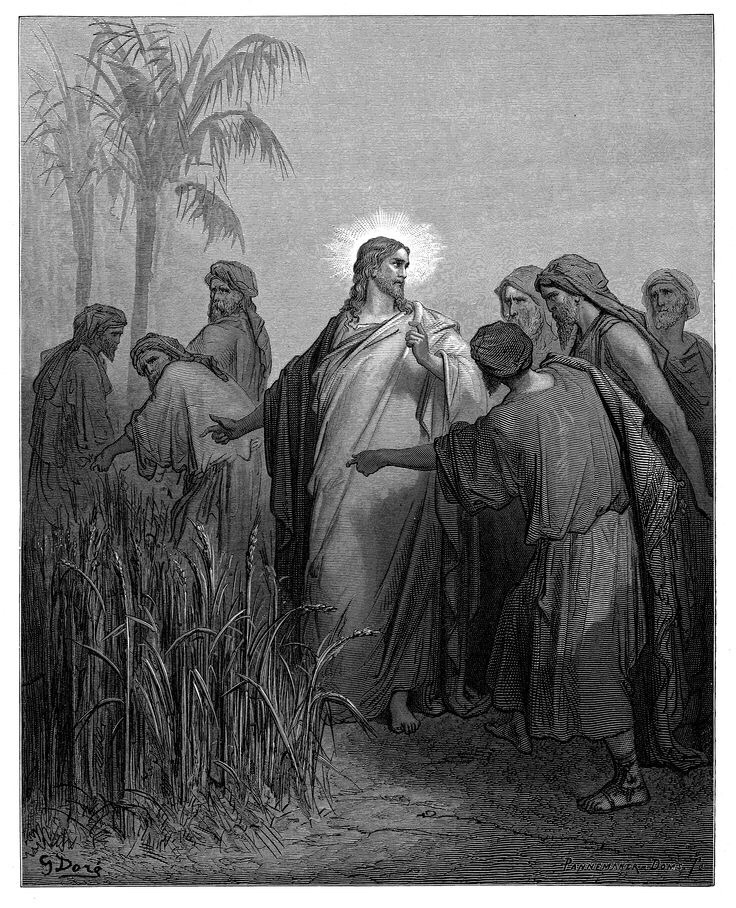
On a Sabbath, while he was going through the grainfields, his disciples plucked and ate some heads of grain, rubbing them in their hands. But some of the Pharisees said, “Why are you doing what is not lawful to do on the Sabbath?” And Jesus answered them, “Have you not read what David did when he was hungry, he and those who were with him: how he entered the house of God and took and ate the bread of the Presence, which is not lawful for any but the priests to eat, and also gave it to those with him?” And he said to them, “The Son of Man is lord of the Sabbath” (Luke 6:1-5).

This passage gives us fits if we think that Jesus is flexing His muscle as “Lord of the Sabbath,” carving out exceptions in the Sabbath law. The arbitrariness that such an interpretation requires should make us uneasy. It is true that God the Father has the authority to change His mind arbitrarily if He wants, but an important part of His character is that He doesn’t (Num. 23:19). Is God the Son really just brushing aside the Sabbath law because His disciples are hungry?

Such an interpretation of this episode requires us to believe that the Pharisees are correct in their interpretation of the Law. We must take care when we consider what captor Jesus came to defeat in Luke 4:18. Equating Pharisaism with the Law makes the Pharisees and the Law of Moses the oppressor holding Israel in bondage.

Let us study the question and see whether the Law is really as oppressive as the Pharisees’ interpretation of it.

What does the Law itself say about the disciples’ actions? The general Sabbath laws are rather vague; they require that the people abstain from “any work” (Ex. 20:8-11; 31:12-17; Lev. 23:3). Exodus 34:21 comes closest to addressing this situation: “Six days you shall work, but on the seventh day you shall rest. In plowing time and in harvest you shall rest.” The Law therefore prohibits sowing or harvesting on the Sabbath day, which is consistent with the restrictions of the Sabbath year and the year of Jubilee (Lev. 25:4-5, 11).

Is this the legal basis for the Pharisees’ condemnation? Not quite. Calling the disciples’ actions “reaping” is a stretch. The Pharisees must interpret the Law through scribal tradition to reach this judgment. As we have seen, most of the Sabbath laws are vague. The Jews of the Second Temple period wanted to know just what constituted “work” under the Law, so the scribes created standards for the people to operate under. The scribal tradition for the Sabbath equated“plucking” with “harvesting” and “rubbing” with “threshing,” which is how the Pharisees arrive at their conclusion that Jesus’ disciples are doing work in violation of the Sabbath.

Let us return to the Law to see if it informs this scribal reading. In Deuteronomy 23:24-25, Moses distinguishes between plucking and eating out of a vineyard or a field of grain on the one hand, and putting in the sickle and gathering into a bag on the other. The laws for the Sabbath year and the year of Jubilee carry this idea forward. The people of Israel were not to reap the “wild” produce of the field; to do so would violate the land’s Sabbath rest (Lev. 25:5, 11). They could, however, eat from the field or the vineyard directly, which would not violate the land’s Sabbath rest (Lev. 25:7, 12).

Thus the Law shows us that the Pharisees’ interpretation is wrong on both counts: “plucking” is not the same as “reaping,” and eating directly out of a field does not violate Sabbath rest. The Pharisees’ scribal reading of the Law led them to restrict the Sabbath in a way which God Himself did not do. In other words, they bound where God did not bind.

The Law condemns such behavior. God tells Israel, “You shall not add to the word that I command you, nor take from it, that you may keep the commandments of the Lord your God that I command you” (Deut. 4:2). Disobedience to the Word is not just a matter of ignoring what God has said; it is also a matter of making things up which God never said.

We must understand the Pharisees’ motives for restricting the Sabbath and beware. The scribal tradition likely started with a desire to follow a vague law well. Surely we can sympathize. Take care, Christian, for the Adversary still uses this trick to lure people away from the pure Word of God. What begins as a set of standards to clarify a vague command morphs into an unbiblical restriction that we place not only on ourselves but on others. Woe to the man who puts his standard on the same level as Almighty God’s!

Header: detail from Gustav Doré, “The Disciples Plucking Corn on the Sabbath”

img_5842